













By Steve Berg, Vice President, Encompass Group
Infection prevention is central to healthcare, and healthcare textiles (HCTs) play a quiet but critical role. A fomite is any inanimate object that, when exposed to infectious agents, can serve as a vehicle for transmission. Textiles fall into this category, which has led to recurring questions about their potential role in healthcare-associated infections (HAIs).
The CDC maintains that the actual risk of infection from properly laundered HCTs is negligible. Still, researchers continue to study how pathogens survive on fabrics like cotton, polyester, and blends. Studies show that microorganisms such as VRE and MRSA can survive on textiles for days even weeks, if items are not processed. The Healthcare Laundry Accreditation Council (HLAC) confirms that HCTs should be considered fomites, reinforcing the need for rigorous laundry practices.
The Chain of Infection

Pathogen presence on a fabric surface does not automatically lead to infection. Transmission requires:
· A sufficient number of pathogens present.
· Contact with virulent or harmful microorganisms.
· A susceptible host, often someone with a weakened immune system.
· A means of transfer, typically via touch or contaminated surfaces.
Breaking this “chain of infection” is where commercial laundries prove essential.
Processing: Where the Risk is Controlled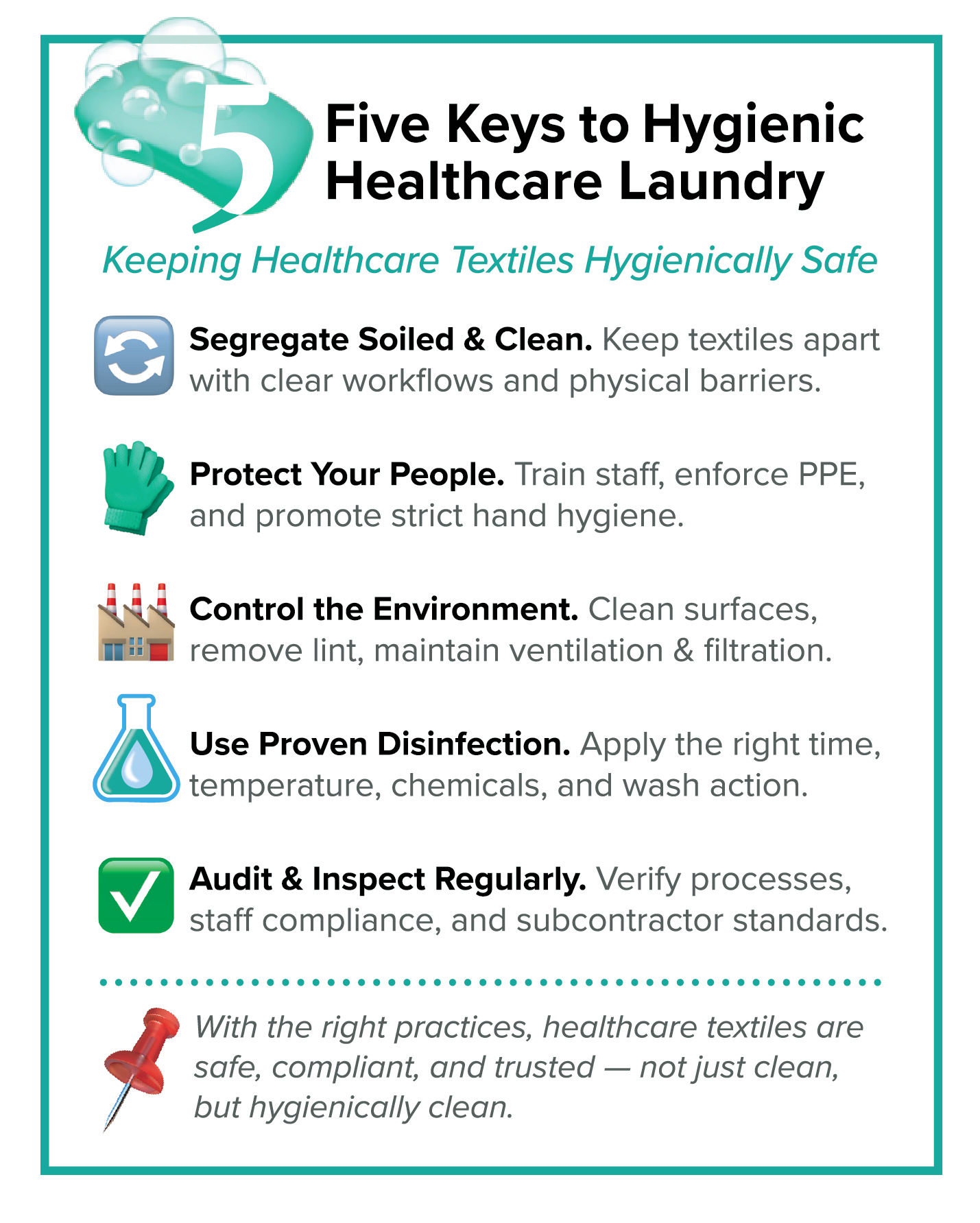
The CDC’s Guidelines for Environmental Infection Control in Healthcare Facilities stress that safe handling, transportation, and laundering are what keep infection risks negligible. Commercial laundries already employ scientifically validated processes that address the critical factors:
· Segregation: Keep soiled and clean textiles physically separated, with clear workflows and barriers.
· Handling & PPE: Staff must be trained, equipped with gloves, gowns, and eye protection, and supported by ongoing hygiene education.
· Facility Hygiene: Clean floors, walls, ceilings, and equipment regularly; ensure ventilation and lint control; and inspect facilities frequently for risks.
· Disinfection Factors: Ensure effective time, temperature, mechanical action, water quality, and chemistry (such as bleach, hydrogen peroxide, or peracetic acid).
Properly executed, these practices prevent cross-contamination and protect both healthcare workers and patients.
Why This Matters for Laundries
Healthcare textiles will continue to be scrutinized as potential fomites – but for laundries, this underscores the value of rigorous standards and transparent practices. Accredited facilities that follow HLAC, CDC, and industry guidelines provide assurance that their textiles are not just clean, but hygienically safe.
The conclusion for commercial laundries is clear: the role of HCTs in infection transmission remains negligible when professional processing, handling, and facility practices are followed. This is not only a compliance requirement, but also a point of competitive distinction in an industry where patient safety and healthcare outcomes are tied directly to laundry operations.

About the Author: Steve Berg is Vice President of Sales for Senior Living, Government & Laundry for Encompass Group, LLC. He can be reached at steve.berg@encompassgroup.net.
